

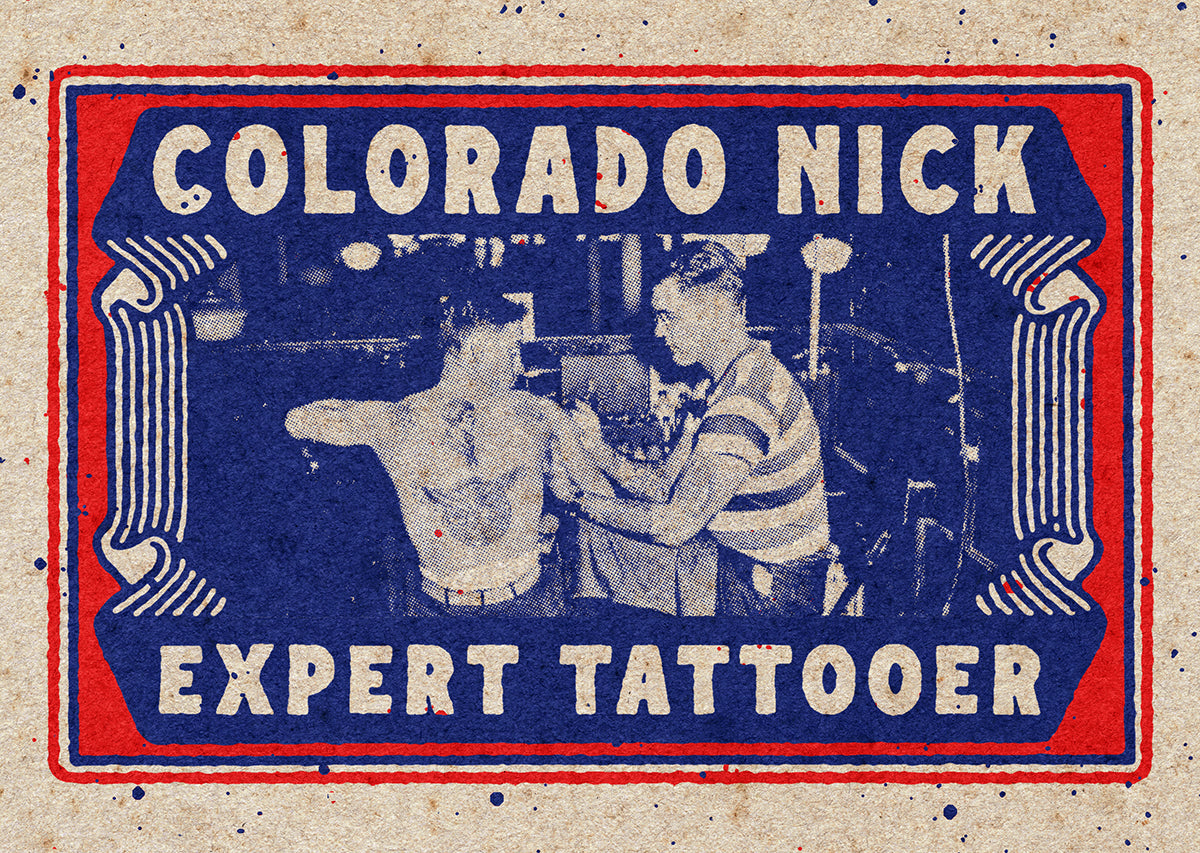
I first heard the name Colorado Nick about twelve years ago. I had stopped an older gentleman at the grocery store to ask who had done the tattoo on his arm. He told me it was done by Colorado Nick. I didn’t ask any follow-up questions at the time. Looking back, I wish I had. For several years, that brief exchange was all I knew. Not long after, Colorado Springs tattooer Snake Yates announced his retirement. I purchased the flash off the walls of his longtime shop on Platte Avenue. When my wife Kayla and I went to pick it up, we spent hours talking with Snake about local tattoo history. He mentioned two tattooers from the generation before him in the 1950s and 60s: Robert Alexander and Colorado Nick Wisner. Alexander worked downtown and was known for painting his flash on sheets of glass. Nick tattooed just up the street, on the southeast corner of Colorado and Tejon, in the back of a popular pool hall called Recreation Billiards. He had built out a small shop there to capitalize on the steady flow of servicemen who passed through the hall. Colorado Springs has long been a military town, and the timing was no accident. Snake had been tattooed by Nick four times in the late 1960s. He showed us the work that day. The one that stood out most to me was a classic rose on his leg clean, balanced, and beautifully done. It left an impression.

Years later, Henry Goldfield told me that when he was tattooing in Denver in the 1960s, he would ride his motorcycle down to Colorado Springs to help Nick on military paydays because the workload was more than one man could handle. Considering the concentration of Army and Air Force bases in the area, it’s not hard to imagine how busy that pool hall must have been at the end of the month. Nick was born and raised in Victor, Colorado. His father rose from being a homeless orphan to holding a high position at one of the gold mines there. Nick himself ran pressure drill teams in mines throughout Colorado and Arizona before turning fully to tattooing. He lived a largely nomadic life and worked in several military hotspots around the country.

I’ve heard from multiple sources that while working on State Street in Chicago, Nick was beaten by members of the mob and forced to return to Colorado Springs to live with his mother, Mary. The story goes that he suffered a serious head injury that affected him for the rest of his life. Records and accounts suggest he also worked in North Carolina, Hawaii, and Phoenix, and at different times worked alongside figures such as Huck Spaulding and George De Silva. I’ve been collecting vintage tattoo flash and photographs for over seventeen years, and from the moment I learned more about Nick, I began searching for his work. It was not easy to find. Slowly, over time, I was able to piece together a meaningful collection of his hand-painted flash. Many of his sheets had been misidentified over the years as Nick Picaro’s, since most were simply signed “Nick” in cursive at the bottom.

While working on the Old Glory book, I already knew that Quincy Lee Cooper had learned to tattoo from Nick after being discharged from the Army at Fort Carson. Lee was an avid pool player and met Nick at Recreation Billiards. As I acquired more of Nick’s flash, I began to recognize something: a number of designs in Old Glory were originally Nick’s. Lee had either received them directly from Nick or repainted them in a very similar style. Several of Lee’s sheets contain clear echoes of Nick’s hand.
Old Glory went on to become one of our most widely referenced books. It has circulated far beyond Colorado, finding its way into shops and private collections around the world. There’s a good chance that if you’ve tattooed from that book, you’ve made a few dollars from one of Nick’s designs. There’s also a good chance that someone walking around today is wearing one of his images without ever knowing the name of the man who first painted it. That’s the nature of tattooing. Designs are repeated. Passed hand to hand. Reinterpreted. Carried forward.
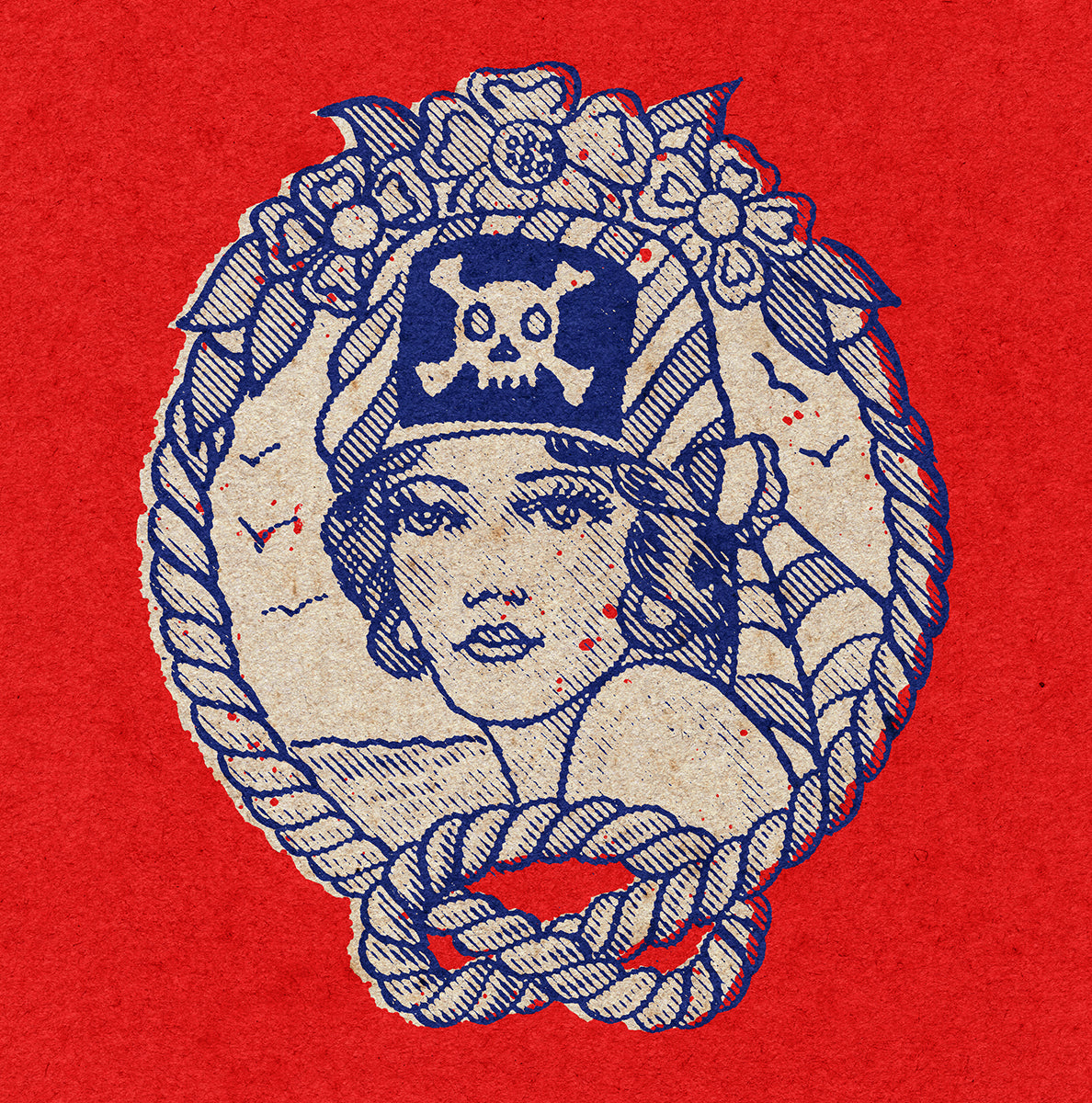

As my research continued, I discovered that Nick was buried in Evergreen Cemetery in Colorado Springs. I went to pay my respects and brought a few of his original paintings with me. When I arrived, I found that he was buried in an unmarked grave in a family plot next to his mother. We arranged to have a headstone made. Moises and I collaborated on the design, drawing directly from Nick’s own flash. After years of studying his work and preserving what survived, it felt like the right thing to do. There’s an old saying that we stand on the shoulders of giants. In tattooing, that’s not just a metaphor. Every line we pull, every rose we paint, every eagle or heart or banner we tattoo exists because someone before us refined it, repeated it, and kept it alive long enough for it to reach our hands. Nick may not be as widely known as some of the more celebrated names of his era, but his influence runs quietly through the craft. His designs moved through Colorado Springs, into Denver, across military towns, and eventually into books and collections that have traveled around the world. His place in tattoo history is real, whether his name is attached or not.
If you’re in Colorado, I encourage you to visit Evergreen Cemetery. He is buried in Section B, Lot 141. Stop by. Pay your respects. Remember that the work we do today is built on the labor of people who often worked in obscurity, on the fringes, without recognition. Keeping their names alive is the least we can do.


